
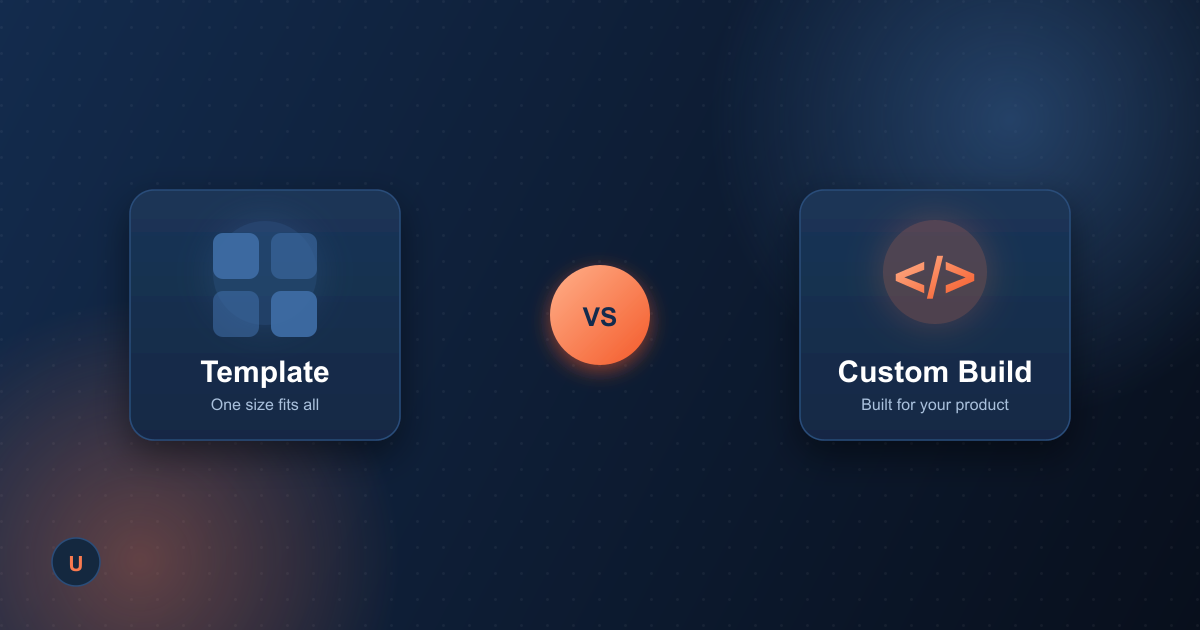
Most businesses start with a template — a WordPress theme, a Squarespace site, a no-code builder. That's the right call early on: it's fast, cheap, and gets you online. But there's a point where the template starts working against you instead of for you.
The signs you've outgrown a template
- You're fighting the plugin stack. Every new feature means another plugin, and every plugin is another thing that can break on the next update.
- Performance is capped. Generic themes ship far more CSS/JS than your site actually uses, and there's only so much you can optimize without rewriting the theme itself.
- The product idea doesn't fit the mold. Marketplaces, booking flows, dashboards, and anything with real business logic quickly hit the limits of what a website builder was designed for.
- You need it to scale. Templates are built for content sites, not for handling growing traffic, complex data, or integrations with other systems.
What custom development gets you
A custom-built application — like what we do with the MERN stack (MongoDB, Express, React, Node.js) — means:
- Only the code you need. No plugin bloat, no unused framework weight.
- Full control over the data model. Build exactly the features your business logic requires, not what a template author anticipated.
- Room to grow. Add features, integrate APIs, and scale infrastructure without hitting a platform's ceiling.
It's not all-or-nothing
You don't have to rebuild everything on day one. A common path we see: start with a fast marketing site, then layer in custom-built features (a dashboard, a booking system, a marketplace) as the business needs them.
If you're starting to feel the limits of your current setup, that's usually the right time to have this conversation — not after the limits have already cost you a launch deadline.