
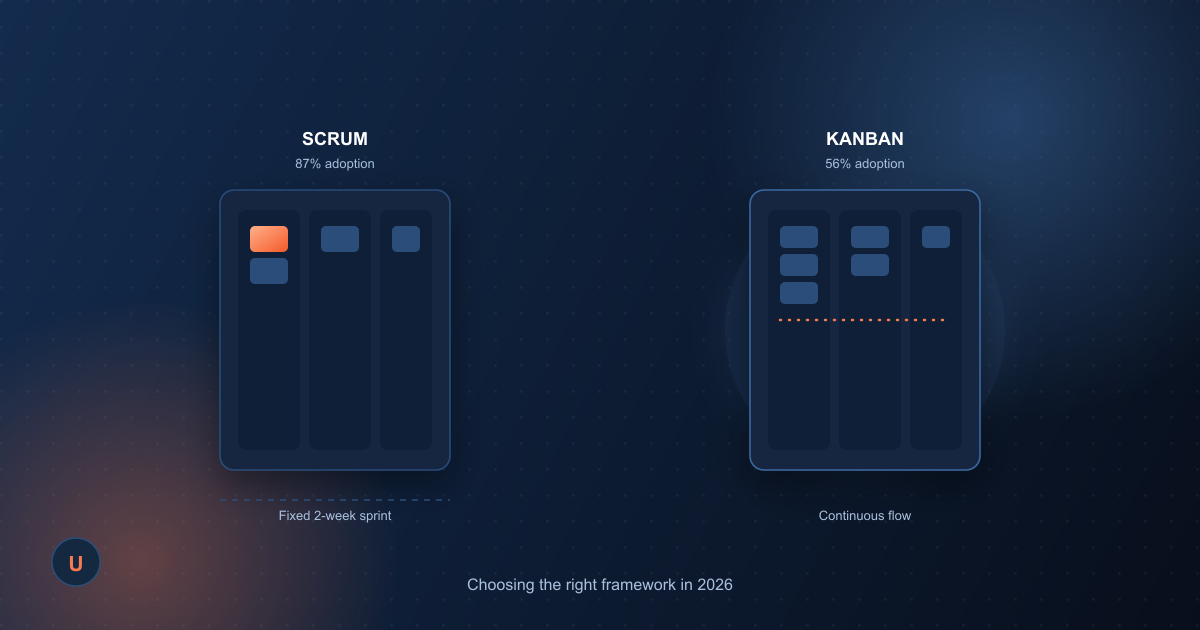
Scrum wins the popularity contest by a wide margin: 87% of Agile teams use it, versus 56% for Kanban (Echometer). That's not the same as it being the right choice for your team. The two frameworks solve different problems, and picking the popular one by default is how teams end up running sprint ceremonies for work that never fit into sprints in the first place.
What actually separates them
- Scrum structures work into time-boxed sprints with a fixed start, fixed end, and committed scope. Delivery is driven by the calendar: you commit to a sprint goal, then ship it on schedule.
- Kanban has no sprints, no required roles, and no mandatory ceremonies. Delivery is driven by flow: work moves continuously through the board as capacity allows, not on a fixed cadence.
- Tracking differs accordingly. Scrum measures velocity and sprint-goal completion. Kanban measures flow metrics like lead time and throughput (Monday.com).
When Scrum actually wins
Scrum fits predictable work that benefits from regular planning: cross-functional teams building features toward stakeholder demos, where a sprint review is a genuinely useful checkpoint, not just a calendar entry. If your roadmap is reasonably stable for 1-2 week stretches and stakeholders want to see progress on a rhythm, Scrum's structure earns its overhead.
When Kanban actually wins
Kanban excels where priorities change faster than a sprint boundary allows: support teams, ops-heavy work, and continuous deployment environments where "ship it when it's ready" beats "ship it on Thursday." Forcing that kind of work into two-week sprints usually just means constant scope renegotiation mid-sprint, which defeats the point of having sprints at all.
Why most teams don't pick just one
A meaningful share of teams that report using "Scrum" are really running a hybrid, sometimes called Scrumban: sprint-length planning horizons and demos, but a continuous-flow board instead of a rigid sprint backlog. That's not a compromise, it's often the honest answer once a team has real production support work sitting alongside planned feature work, which is closer to how most software teams actually operate.
Picking one for your team
The framework name matters less than whether your tracking matches how the work actually arrives. If you're re-planning mid-sprint every sprint, that's a signal your work is Kanban-shaped even if your ceremonies are Scrum-shaped. If you're evaluating project and product management support and want a process that fits how your team actually works instead of a methodology chosen by default, get in touch.
Sources: Echometer — Scrum Statistics 2026, Monday.com — Kanban vs Scrum: Choosing the Right Agile Method in 2026