
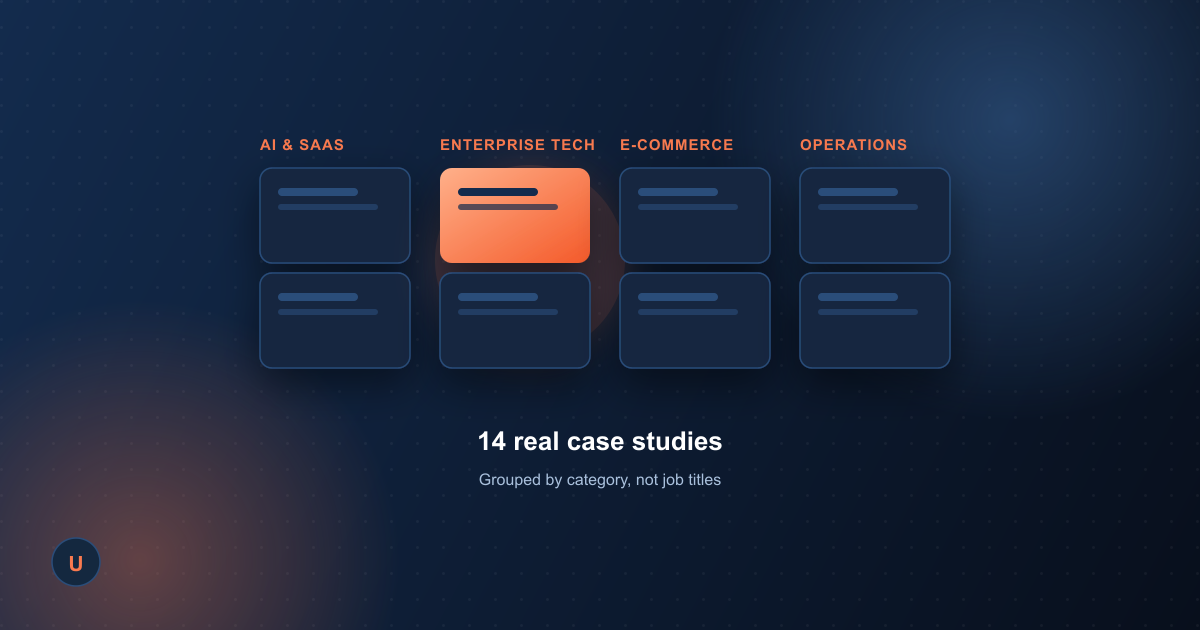
Our Portfolio page used to be two cards: a job title, a one-line summary, a couple of tags. Technically accurate, but not remotely useful if you were trying to figure out whether we've done work like yours before. A prospective client reading that page had no real way to tell what either engagement actually involved, what we were responsible for, or whether the work led anywhere. So we rebuilt it as what it should have been from the start: real case studies with real detail behind them.
What changed
- 14 real engagements, grouped into six categories instead of one flat list: AI & SaaS, Enterprise Technology, E-commerce & Digital Commerce, Healthcare Technology, Operations & Business Transformation, and Digital & Marketing. Nothing in there was padded out to fill a category; if we hadn't genuinely done a certain kind of work, that category just has fewer entries.
- Every project now has its own page at
/portfolio/<slug>, built around a consistent structure: Overview, My Responsibilities, What I Built & Managed, Technology & Tools, and Results. That last section is conditional on purpose. Most engagements don't have one, because most engagements don't have a single, clean, quotable outcome. WearWellow does, since we actually took that business from $0 to $1M in sales, and that's the kind of claim we only make when it's true and specific. - Responsibilities are separated from deliverables. "What I Built & Managed" covers the concrete systems and areas we owned. "My Responsibilities" covers the ongoing duties the role actually required, day to day, not just the finished output. Those are two different questions, and most portfolios only answer one of them.
- The homepage now features five flagship engagements, spanning a government technology implementation, an enterprise integration program, WearWellow, Xenopsi, and a business systems consulting engagement, instead of whichever three happened to load first in the old grid.
Why the categories exist at all
Six categories is a deliberate structure, not a default. AI & SaaS and Enterprise Technology cover work that's technically dense: agent lifecycle management, RBAC and permission architecture, multi-team integration programs. E-commerce & Digital Commerce and Healthcare Technology cover regulated or revenue-critical delivery, where accuracy and process matter as much as speed. Operations & Business Transformation and Digital & Marketing cover the business and growth side of the same skill set. Grouping the work this way makes it obvious at a glance whether we've done something close to what you need, rather than making you read all 14 entries to find out.
Why this took actual editorial judgment
A few of these entries describe a practice area, like healthcare SaaS implementations or enterprise microservices architecture, rather than one named client. That's honestly how the work breaks down, and we weren't going to invent a company name just to make it look like a single tidy engagement. We also didn't attach client names anywhere we couldn't confirm they were publishable, even where naming them would have made for a stronger-looking case study. If a project doesn't have a real, stated outcome, it doesn't get a Results section. A portfolio that can't tell the difference between "we did this" and "this worked" is one nobody should trust, and we'd rather have fewer strong claims than a page full of weak ones.
Take a look
The full portfolio is organized by category now, or jump straight to a flagship case study like our enterprise integration program or our business systems and operations consulting work. If you're evaluating us for something similar, get in touch and we'll tell you honestly whether we've done it before.